Intersectional Things in the Early Modern World
Interdisciplinary Workshop with Holly Fletcher (UCL), Carolin Schmitz (Trier), Lavinia Gambini, and Andreas Berger
Thursday & Friday, November 19–20, 2026, University of Bern, Mittelstrasse 43, rooms 320 (Thu) and 120 (Fri)
How did things shape unequal social worlds, and how did social inequalities shape what things could do? Different people did not encounter the same things in the same ways. Access to objects (and their uses, meanings, and effects) was informed by intersecting social distinctions and inequalities, including gender, race, ethnicity, age, disability, religion, and social status. This workshop examines how such differences governed the roles that things, matters, and substances played in everyday life, religious practice, political culture, domestic settings, commerce, medicine, and beyond.
Welcoming international guests as well as Bern-based scholars, this early-career workshop will explore these questions through a series of close studies of objects, collections, practices, spaces, and archives.
The workshop will provide an opportunity to reflect on broader conceptual implications. What happens when intersectional approaches meet recent work on material agency and/or multispecies history? How may an intersectional approach—designed to analyse inequalities among people—change when the material things under investigation are themselves treated as agents, environments, companions, living non-human beings, or spirited things?
***
Participation is open to all interested students and members of the academic mid-level staff (Mittelbau). Please register by contacting either lavinia.gambini@unibe.ch or
andreas.berger-gehringer@unibe.ch.
Please contact the organizers to receive the Zoom link to attend the keynote lectures.
Ulteriori informazioni sugli eventi
Informazioni sui costi
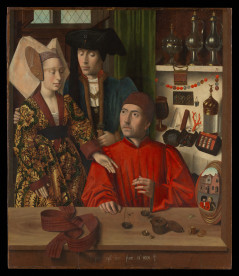
Petrus Christus, A Goldsmith in His Shop (1449), The Metropolitan Museum of Art, Public Domain: https://www.metmuseum.org/it/art/collection/search/459052.