Argument:
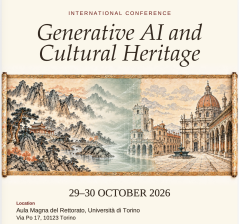
Cultural heritage - defined as the tangible and intangible legacy that is passed down from generation to generation - has always been sensitive to technological innovation. From photography to film, from computing to the Internet, from social media to virtual reality, cultural preservation, exhibition, communication and memory has been informed by the introduction of media innovations, and institutions such as museums, archives and libraries have often been early adopters of new technologies. Technological companies such as internet platforms have also been active in protecting and innovating cultural heritage for either commercial or public purposes. The development of Generative AI signals a new episode in this trajectory. Systems such as Large Language Models (LLMs) and text-to-image models provide new resources for institutions, platforms, practitioners, and users to engage with the historical record, produce text and audiovisuals related to cultural heritage, and access historical sources. Through a combination of interdisciplinary keynotes, paper presentations and roundtables, this conference aims to illuminate the implications of these emerging practices and approaches.
As argued by Nieto McAvoy & Kidd (2024), these changes and processes lead to the emergence of “synthetic heritage,” understood as the activation of generative AI to blend authentic historical elements with artificial enhancements. Synthetic heritage opens new pathways of engagement with the public, but also raises several challenges and potential risks: for instance, AI’s uneasy relationship with accuracy and the propensity of LLMs to hallucinate invites questions about its capacity to ensure historical validity and appropriate reliance on sources (Schuh, 2024; Matei, 2024). Synthetic heritage, moreover, invites scholars and practitioners to reconsider existing notions and discussions as well as to imagine new ways to capture and make sense of the ongoing change. The conference will create a forum where theoretical notions such as authenticity, cultural memory, and heritage can be taken into account and rediscussed in the context of changing technological systems.
The conference is sponsored by Global Media and China, a Sage journal that pursues an international approach to original research, and hosted by the Scuola di Studi Superiori Ferdinando Rossi, University of Turin.
Programme
Day 1 – 29 October 2026
Aula Magna del Rettorato, Università di Torino
Via Po 17, 10123 Torino
2:00pm–2:15pm | Welcome
- Simone Natale (University of Turin, Italy)
- Deqiang Ji (Communication University of China)
- Anthony Fung (The Chinese University of Hong Kong)
- Dianlin Huang (Communication University of China)
- Vincenzo Crupi (President, Scuola di Studi Superiori Ferdinando Rossi, University of Turin, Italy)
2:15pm–3:45pm | Panel 1: Synthetic Evidence: Hallucination, Misinformation, and Visual Heritage
Chair: Deqiang Ji (Communication University of China)
- Sheenagh Pietrobruno (University of Ottawa, Canada)
Tactics to Counter AI Misinformation in Cultural Heritage: Leveraging the Materiality of Mid-century Material Culture in Archival Research - Markos Konstantakis (University of the Aegean, Greece), Emmanouil Choustoulakis (University of Peloponnese, Greece), Eleftheria Iakovaki (University of Athens, Greece), Lavinia Chiara Tagliabue (University of Turin, Italy), Rossana Damiano (University of Turin, Italy) & Pinelopi Athanasopoulou (University of Peloponnese, Greece)
The Curator and the Code: Hallucinating Heritage in the Age of Generative AI - Michele Varini (Università Cattolica del Sacro Cuore, Italy)
Seeing the Synthetic Past: Towards a Visual Methodology for Analysing AI and Cultural Heritage - Jiaoya Huang & Jianghong Liu (Communication University of China)
Synthesizing Digital Cultural Heritage: A Study of Authenticity Constraint Mechanisms in the Digitization of Silk Artifacts
3:45pm–4:00pm | Break
4:00pm–5:30pm | Panel 2: Synthetic Pasts: Memory, Mourning, and Cultural Identity
Chair: Dianlin Huang (Communication University of China)
- ChengDong Wang (Universiti Malaya, Malaysia)
From Spirit Photography to AI Resurrection: Generative AI, Synthetic Heritage, and Digital Mourning in East Asia - Rieke Böhling (University of Bremen, Germany)
Between Hobby and Professionalism: Generative AI and Genealogy - Mingkun Li (University of Westminster, UK)
Thin Memory Work: Configuring Human–AI Agency in AI-Generated Socialist Heritage Videos - Long Yi & Xinyi Li & Xinrui Huang (Central South University, China)
Constructing Collective Memory in the Era of Synthetic Heritage: Measuring the Value Orientation of ShanhaiXuanji through Hofstede's Cultural Dimensions
5:30pm–6:30pm | Keynote
- Eva Nieto McAvoy (King’s College London, UK)
AI Afterlives: The Making of Synthetic Heritage
Day 2 – 30 October 2026
Aula Magna del Rettorato, Università di Torino
Via Po 17, 10123 Torino
9:30am–11:00am | Panel 3: Heritage Institutions and AI Mediation: Archives, Museums, and Chatbots
Chair: Anna Maria Marras (AVICOM & University of Turin, Italy)
- Luigi Emanuele Di Marco (Associazione Archivio Storico Olivetti, Italy)
Heritage as Knowledge Infrastructure: OLO and the Future of Conversational AI Grounded in the Olivetti Archives - Sara Santambrogio (AICHeM - Associazione Italiana Corporate Heritage Manager)
From Heritage Custodian to AI Mediator: The Strategic Role of the Corporate Heritage Manager in the Age of Phygital Heritage - Luca Befera (University of Turin, Italy)
Generative AI for the valorisation of cultural heritage: Interconnections and differences between information retrieval and interactive storytelling - Katherine Miller (Cornell University, US)
Beyond Realism: Rethinking Approaches to Virtual Reality in Art Museums as a Technology of Display and Reproduction
11:00am–11:15am | Coffee break
11:15am–12:30pm | Roundtable discussion: Generative AI: Opportunities and Challenges for Cultural Heritage Institutions
Speaker: Alessia Tripaldi (Sineglossa, co-author of AI Compass for Cultural Heritage)
Discussants: Simona Casonato (Museo Nazionale della Scienza e della Tecnologia Leonardo da Vinci), Rossana Damiano (University of Turin, Italy), Dianlin Huang (Communication University of China), Deqiang Ji (Communication University of China)
Moderator: Enrico Natale (Infoclio, Switzerland)
12:30pm–2:15pm | Lunch
2:15pm–3:45pm | Panel 4: Living Heritage: Participation, Safeguarding, and Algorithmic Authenticity
Chair: Simone Natale (University of Turin, Italy)
- Haoyu Huang (Wuhan University, China)
From AI-Generated Experience to Participatory ICH: Effects of Generative AI Interaction on Authenticity Perception, Cultural Identity, and Participation Intention in Miao Embroidery - Hong Yang (Communication University of China, China)
Categorized Safeguarding of Intangible Cultural Heritage under the 2003 Convention: Prospects for AI Application - Lu Lu (Communication University of China, China)
Synthetic Heritage and Algorithmic Authenticity: Comparing Chinese Shadow Puppetry Narratives Generated by Domestic and Global Large Language Models - Chang Zhang (Communication University of China, China) & Jiayi Fu (Beijing Normal University, China)
Algorithmic Thresholds of Memory: Generative AI and the Spatial Politics of Trans-Eurasian Heritage
3:45pm–4:00pm | Coffee break
4:00pm–5:30pm | Panel 5: Governing AI Heritage: Sovereignty, Locality, and Contested Knowledge
Chair: Viviana Patti (University of Turin, Italy)
- Di Wu (Communication University of China, China)
Who Teaches AI to Remember? Generative AI, Heritage Sovereignty, and Postcolonial Built Space in Southern Africa - Xiao Shen (Communication University of China, China)
The Locality Predicament of “Synthetic Heritage”: A Double-Paradox Analysis and Governance Framework for Generative AI-Mediated Intangible Cultural Heritage Memory - Martin Fredriksson (Linköping University, Sweden)
Traditional-knowledge databases and generative AI - Graham Newman (Royal College of Art, UK)
Archival Activation and Synthetic Heritage: Generative AI, Contested Design Knowledge and the RCA Department of Design Research Archive
5:30pm–6:30pm | Closing roundtable: Generative AI, media and cultural heritage in a global perspective
Speakers: Anthony Y.H. Fung (The Chinese University of Hong Kong), Dianlin Huang (Communication University of China), Deqiang Ji (Communication University of China), Eva Nieto McAvoy (King’s College London, UK), Daya Thussu (Hong Kong Baptist University)
Moderator: Simone Natale (University of Turin)
Veranstaltungsort
Contatto
Ulteriori informazioni sugli eventi
Informazioni sui costi
Inscrizione