This international conference examines the history of confinements through the lens of their materiality. Indeed, confinement is defined by walls that separate individuals from society. Beyond the mere walls, daily interactions between confined individuals, institutional authorities, and staff are largely paved and defined by a variety of things: food, water, books, graffiti, clothes, money, letters, official registers, medicine, punishment objects, etc. In this regard, and drawing on the material turn in history since the early 2000s, things – whether “tangible” things physically available to historians or “textual” things described in written sources – might offer an additional perspective on the history of confinements more broadly, especially when addressing forms of “prison before the prison”. Drawing on a recent historiographical broadening of the field, the conference aims to address various forms of medieval and early modern confinement, both judicial and non-judicial: prisons, galleys, hospitals, workhouses, cloisters, monasteries, and the like. At the same time, it seeks to reflect on methodological questions pertaining to material history as an approach and to the sources that underpin it.
Ce colloque international se propose d’explorer les enfermements à l’aune de leur matérialité. De fait, les objets et les choses se situent au centre des expériences d’enfermement, défini après tout par la présence physique de murs séparant les individus de la société. Outre les murs, les interactions quotidiennes entre les individus enfermés, les autorités et le personnel de l’institution sont largement caractérisées et définies par un large éventail de choses : la nourriture, l’eau, les livres, les graffitis, les habits, l’argent, les lettres, les registres d’écrou, les médicaments, les objets de punition corporelle, etc. De ce point de vue, à la suite du material turn depuis le début des années 2000, les choses – qu’elles soient « tangibles », c’est-à-dire conservées et à la disposition des historien·ne·s, ou « textuelles », soit décrites dans les sources – pourraient offrir une perspective innovante sur l’histoire des enfermements, tout particulièrement concernant les formes de « prison avant la prison ». Se basant sur un récent élargissement du champ de recherche, le colloque porte sur diverses formes d’enfermement médiéval et moderne, à la fois judiciaires et non judiciaires : prisons, galères, hôpitaux, maisons de travail, couvents, monastères, etc. Par la même occasion, il s’agit de mener une réflexion sur l’histoire matérielle comme méthode et sur ses sources.
Further information and program
Keynote lecture : prof. Sophie Abdela (University of Sherbrooke) : « If These Walls Could Speak! An Incursion in Paris’ Jailbreaks (1700-1790) ».
Round table with Frances Andrews (University of St Andrews), Renaud Morieux (University of Cambridge), Natalia Muchnik (Ecole des hautes études en sciences sociales), Giorgio Riello (European University Institute).
The conference is free of charge and will be held in person and online.
No registration is required to attend in person.
To attend online, please contact nathalie.dahn-singh@unil.ch.
Contatto
Ulteriori informazioni sugli eventi
Informazioni sui costi
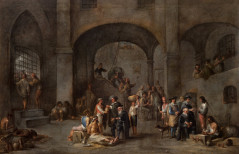
Cornelis de Wael, “To visit the Imprisoned”, ca. 1640, oil on canvas, 99 x 152 cm, © Musei di Genova.