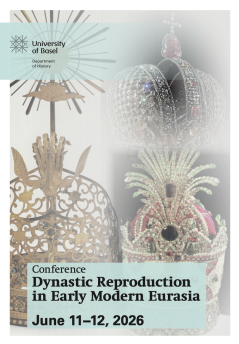
Dynastic rule was the most widespread form of political organization in the world well into the nineteenth century. However, dynasties had one major weak point: their continuity depended on (usually male) offspring. Recent comparative studies have shown that this problem was especially acute for European dynasties because of the importance they placed on the Christian principle of monogamy. In his study “Dynasties: A Global History of Power”, Jeroen Duindam has thus shown that we find different dynastic patterns in different regions of the pre-modern world. While in early modern sub-Saharan Africa a clustering of matrilineal, polygynous dynasties can be observed, in large parts of Asia patrilineal, polygynous dynastic patterns prevailed. In Europe, a patrilineal, monogamous pattern was dominant in the early modern period.
This conference aims at bringing together experts of different early modern Eurasian empires to shed more light on their patterns of dynastic reproduction in a comparative perspective. It brings together contributions adopting approaches of kinship, gender, and global history as well as of history of political culture. Topics addressed include the ways in which marriage rules and patterns affected dynastic reproduction; cultural practices surrounding pregnancy, childbirth, and early childhood at dynastic centers; the role of family members (mothers, aunts, siblings) and servants in the upbringing of princely children; genealogical knowledge and succession; spiritual kinship; and succession crises.
Programm
Thursday, June 11, 2026
09:00: Introduction Nadine Amsler and Pascal Firges (University of Basel)
Panel 1: Dynastic Procreation and Children
Chair: Sabine Dabringhaus (University of Freiburg)
9:30: Ellen Soullière (Massey University, New Zealand) Women and Children in the Reproductive Politics of the Imperial Family of China’s Ming Dynasty
Coffee Break
11:00: Katrin Keller (Austrian Academy of Sciences) Imperial Children: Pregnancy and Parenting at the Viennese Court in the Seventeenth Century
12:00: Nadine Amsler (University of Basel) Governesses, Physicians, and Wet Nurses: Early Childhood at the Ducal Court of Munich, 1650–1740
Lunch Break
Panel 2: Siblings and Succession
Chair: Pascal Firges (University of Basel)
14:30: Elisabeth Geevers (Lund University) Philip II’s Sisters: The Role of Infantas María (1528−1603) and Juana (1535−1573) in Habsburg Succession and Marriage Scenarios, 1530−1570
15:30: Pia Jolliffe (University of Oxford) Meishō Tennō and Her Tonsured Siblings: Dynastic and Monastic Successions in Seventeenth-Century Japan
Coffee Break
17:00: Jeroen Duindam (Leiden University) Keynote Lecture Generating Royalty: Bodies and Babies in the Global History of Dynasty
Friday, June 12, 2026
Panel 3: Concubines, Slaves, and Adoptees
Chair: Claudia Opitz-Belakhal (University of Basel)
9:00: Betül İpşirli-Argıt (Marmara University, Istanbul) Imperial Concubinage in the Ottoman World, Sixteenth to Eighteenth Centuries
10:00: Anne Walthall (University of California, Irvine) Wives, Concubines, and Adoption and Changes in the Institutional Character of the Shogunate, 1600−1868
Coffee Break
Panel 4: Concepts of Kinship, Family, and Lineage
Chair: Regine Maritz (Swiss National Science Foundation, Bern)
11:30: Anna Kollatz (University of Heidelberg) The ‘Lion-King’: Making Kings by Interactions with Animals in Mughal Historiography
12:30: Markus Friedrich (University of Hamburg) Reproducing and Transmitting Family Knowledge in Early Modern Europe’s Dynastic Settings
Lunch Break
Panel 5: Kinship and Lineage in Elective Monarchies
Chair: Nadine Amsler
15:00: Karénina Kollmar-Paulenz (University of Bern) Body Practices: Rebirth and Political Authority in Buddhist Inner Asia
16:00: Toby Osborne (Durham University) Can We Speak of a Papal ‘Dynasty’? Reflections on the Early Modern Papacy
Coffee Break
17:30: Simon Teuscher (University of Zurich) Concluding Remarks
Veranstaltungsort
Kontakt
Zusätzliche Informationen
Kosten