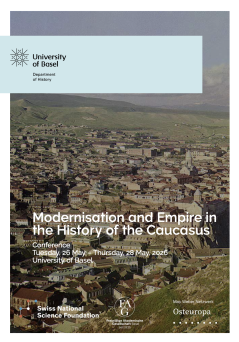
The interest of Western researchers in the history of the Caucasus has increased considerably in recent years. This is due to several factors, all of which are related to Russia’s ongoing full-scale invasion of Ukraine since 2022. The war has sparked a debate about whether the field of Eastern European Studies requires an epistemic process of ‘decolonisation’ that shifts the focus away from imperial metropolises and towards peripheral regions that were historically subject to imperial rule. The current lack of access to archives in the Russian Federation has also prompted historians to look for alternative sources of primary material, and archives in the South Caucasus are proving to be particularly promising. Even in non-academic public discourse, political tensions between the West and both Russia and Iran, the conflict between Armenia and Azerbaijan resulting in the ethnic cleansing of Nagorno-Karabakh in 2023, and Georgia’s increasingly authoritarian domestic politics since the 2024 parliamentary elections have raised awareness of the geopolitical significance of the Caucasus as a bottleneck between Europe and Asia. Against this background, the conference provides a forum to discuss ongoing research and to strengthen an international network of scholars specialising in the history of the region.
The conference explores how ‘modernisation’ was practised and experienced in the Caucasus region during the 19th and 20th centuries, and the extent to which ‘modernisation’ was both a product of and a challenge to imperial rule. In the Russian Empire before 1917, the Caucasus was one of the peripheral regions that were considered ‘backward’ and ‘oriental’ by imperial elites and where the imperial administration attempted to assert its supposed civilisational superiority by pursuing an agenda of socioeconomic and cultural ‘modernisation’. Although the Soviet Union officially denounced imperialism, it continued to rely on a logic of raising the region to the civilisational level of Central Russia while extracting natural resources from the Caucasus for the former imperial core. However, the discourse of ‘modernisation’ served not only to legitimise imperial rule; the local population of the Caucasus had their own visions of ‘modernity’, which did not necessarily align with those of Tsarist and Soviet elites. Focusing on fields ranging from political, economic and infrastructural to environmental and cultural history, participants will discuss how historical actors in the Caucasus understood ‘modernisation’ and howthis impacted their attitudes towards the concepts of nation and empire. Rather than imposing a 21st-century understanding of ‘modernisation’ on historical actors, the conference aims to reconstruct how both imperial elites and subject populations imagined ‘modernisation’, and how these ideas guided their historical actions.
The concept of ‘modernisation’ in imperial history is a topic of debate that is relevant to all researchers focusing on the phenomenon of empire. The decline of classical modernisation theories – rightfully dismissed as Eurocentric – and the rise of postcolonial studies have led to a critical view of the discourse of ‘modernisation’ as a historical instrument for establishing civilisational hierarchies and justifying imperial rule. Some scholars even advocate abandoning the term as a research concept. However, empirical research suggests that historical actors subject to imperial rule did not always confine themselves to defending local traditions against imperialist attempts at ‘modernisation’, but often adhered to their own visions of post-imperial ‘modernity’. Rather than imposing a 21st-century understanding of ‘modernisation’ on historical actors, the conference aims to reconstruct how both imperial elites and subject populations imagined ‘modernisation’, and how these ideas guided their historical actions.
Veranstaltungsort
Zusätzliche Informationen
Kosten