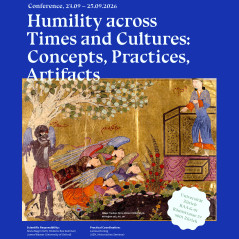
Organized by Silvia Negri (Universität Zürich, Historisches Seminar) and James Weaver (University of Oxford), within the framework of the project “Humility in theory and practice. Historical approaches across cultures (1250–1500)”, the conference aims to broaden both the geographical and chronological scope of the inquiry into historical conceptions and practices of humility.
Humility was omnipresent in premodern societies. It was conceived, practiced and represented as a social, epistemic, religious and aesthetic value. Framed as both a character trait and a bodily posture, taught in a paradigmatic way by sacred figures and exemplary individuals, humility was understood as something that could be acquired and practiced. Its empowering quality was rooted in the belief and experience that “low-ness” is necessary for experiencing “highness”. Humility was associated with the idea that “making space”, through renunciation, stepping back, or refraining from accumulating goods and privileges for the sake of self-praise, is essential for living in community. Moreover, humility was understood and enacted as a condition for learning and for effectively communicating one’s needs, e.g., in prayers or petitions, and closely connected with caring for other bodies. It was recommended to people of all classes and genders, but often articulated in class- and gender-sensitive ways, frequently as an expression or reaction to asymmetric power relations.
The focus of the conference spans the period from 250 CE to 1500 CE and draws on sources from a wide geographical area, including Western Europe, Byzantium, and the Middle East. By centering these regions, we seek to map humility within a space that, for all its cultural diversity, was shaped in significant ways by the three Abrahamic religions: Judaism, Christianity, and Islam. While we do not assume that humility was exclusively or primarily a religious value, there is reason to believe that within the Abrahamic traditions, it was indeed upheld as a virtue, frequently positioned in opposition to pride, which was often viewed as the most dangerous and diabolical of vices.
Conference panels are organized along both chronological and thematic lines, encompassing European Christian regions, Byzantium, Jewish communities, and Islamic territories. Special attention is given to the physical and social spaces in which humility was conceived and enacted, as well as to the interplay between humility and gender.
Veranstaltungsort
Kosten