The workshop aims to analyze the treatment of the relation between the Soviet project of modernization (and modernity) and national and ethnic belonging in films from the Soviet Union, focusing on productions from the Soviet republics other than Russia (RSFSR) since the Thaw era.
As Terry Martin (The Affirmative Action Empire, Cornell Univ. Press 2001) has reconstructed most prominently, the Bolsheviks, after the Russian Revolution, envisioned an ‘indigenization’(korenizatsiia) of communism within the heterogeneous national and ethnic cultures in the dominion of the Russian Empire. This endeavor, obviously, resulted in many excesses of violence and power relations that are today increasingly analyzed—in contrast to what the Soviets would have wished for as their legacy—in terms of colonialism.
The Thaw era, initiated by Stalin’s death and his succession by Nikita Krushchev, gave momentum to a new push for political and, especially, cultural autonomy from Moscow in the Soviet Republics, a process not necessarily halted during the so-called Stagnation period (ca. 1970-1985). In the field of cinema, this gave rise to renaissances and re-inventions of National film traditions, as Jonathan Hirst (Ukrainian Cinema, London/NY 2015) has shown most intriguingly for Ukrainian cinema. Earlier, often monumental Soviet productions like Dziga Vertov’s A Sixth Part of the World (USSR, 1926) and Viktor Turin’s Turksib (USSR, 1929) had pushed for modernization and had portrayed indigenous cultures merely as moribund, cruel, and patriarchal, while nature was perceived in extractivist terms as a bunch of resources. In contrast, the costs of modernization processes―human suffering, material loss, and spiritual alienation―could now be addressed, within negotiable degrees, leaving out, of course, excessive terror. A paradigmatic example is Tolomush Okeev’s The Sky of Our Childhood (Bakajdyn šajyty, Kyrgyzfilm, USSR, 1966), which depicts nomadic pastoralism on the brink of destruction and replaces enthusiasm for progress with a blend of melancholy and sobriety, while criticizing stubborn resistance to inevitable progress.
The workshop wants to ask about the place of culture, and especially cinema, in this picture. James STEFFEN (The Cinema of Sergei Parajanov, Univ. Wisconsin Press, 2013) has shown, for instance, how Sergei Parajanov’s version of the 1960s cinéma d’auteur became the site of the invention of (Ukrainian and Georgian) tradition. How did film construct cultural sites of national and ethnic belonging that were, at the same time, subversive and compliant in relation to the Soviet Modernization project and its newly invigorated project of indigenization? Are culture and film designated as preservational or political and forward-looking? Which emotional registers are activated in the viewers?
Another theme the workshop wants to address is gender relations, and whether films since the Thaw Era reconnect with the Bolshevik program of gender equality by criticizing male domination over women (like The Sky of Our Childhood), or idealize patriarchal gender relations, like Khodzha Kuli Narliyev’s Daughter-in-Law (Gelin/Nevestka, Turkmenfilm, USSR, 1972), relying on increasing trends of conservatism and romanticism in mainstream Soviet cultural ideology.
The workshop is public—registration is not required, but is welcome via email to matthias.meindl@uzh.ch
Mo., June 15th, 2026
15:30 Matthias Meindl: Introduction
15:45 Birgit Beumers: Soviet/Kazakh Schooling in the Films of Abdulla Karsakbaev
16:30 Coffee Break
17:00 Anna Ladinig: Ambiguous Images of Soviet-Kyrgyz Mountainscapes in The Sky of Our Childhood (Bakajdyn šajyty, Nebo nashego detstva,1966)
17:45 Matthias Schwartz: “Watch out! Snakes!” Anti-Colonialism, Emancipation, and Masculinity in Late Soviet Uzbek Adventure Films
18:30 Intermediary Summary Discussion
Di., June 16th, 2026
10:00 Matthias Meindl: Supernatural, Mythical, and Religious Elements in Sergej Parajanov's National(ist) Cinema
10:45 Eugénie Zvonkine: Self-Narrating and Autobiographical Territory as a Vector for a National Cinema in The Sky of Our Childhood (Bakajdyn šajyty, Nebo nashego detstva,1966)
11:30 Coffee Break
12:00 Concluding Discussion
Veranstaltungsort
Zusätzliche Informationen
Kosten
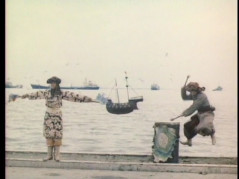
Sergej Parajanov: Ambavi Surams tsikhisa (The Legend of Suram Fortress, Georgia-Film, 1985, 0:28:09)