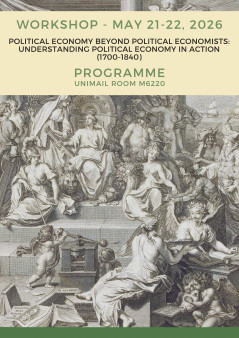
Political economy beyond political economists: understanding political economy in action (1700-1840)
Between the end of the XVIIth century and the middle of the XIXth century, mounting interimperial rivalries and major economic changes (i.e., the industrial revolution) intertwined with a growing formalization of scientific knowledge and, more specifically, the emergence of political economy.
In 1776, Adam Smith famously characterised political economy as “a branch of the science of a statesman or legislator” that aims “to enrich both the people and the sovereign”. However, the role of economists and the subject of their study were still very much undefined at the time. On the one hand, economics as a distinct academic discipline had yet to emerge, and the boundaries with other fields of knowledge such as moral philosophy, natural sciences, or political theology were unclear. On the other hand, discussions of provocative ideas about the origins of wealth, the regulation of markets and freedom of trade were not restricted to closed intellectual circles.
Even though most of early economic debate took place beyond elite intellectual and political spheres, this significant yet elusive portion of economic thinking has largely escaped the attention of conventional histories of political economy. It is only in recent years that a growing stream of research has examined the emergence of economic discourse beyond the scope of prominent figures who came to define the trajectories of modern economic debates.
Building on these innovative approaches, the workshop aims to bring together historians who are working on the nexus between economic discourses and material practices in science, government, trade, manufacturing and agriculture. In studying “political economy in action”, the workshop focuses on neglected actors who intervened in this emerging field of political economy. By bridging the gap between economic discourses and practices, it features new ways to study economic discourse, and to suggest what types of economic arguments played a role in reshaping economic and social practices.
If you have any further questions, please send a message lorenzo.avellino@unige.ch and jean_baptiste.verot@umlp.fr
Veranstaltungsort
Zusätzliche Informationen
Kosten