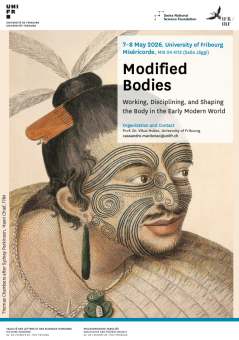
This symposium brings together scholars from across disciplines to explore how bodies were imagined, regulated, and materially transformed between the 16th and 18th centuries. Foregrounding com- parative, praxeological, and interdiscipli- nary approaches, the conference will encourage dialogue between historians of medicine, art and literature, social and cultural historians, anthropologists, and scholars of science and technology. Contributions will address themes such as embodied labor and skill, training and educational technologies, medical and surgical interventions, representations of bodily change, and the entanglement of corporeal practices with religious, politi- cal, and social norms. By doing so, the symposium aims to reframe the early modern body (or rather, bodies) as not a stable given but as a mutable, contested, and productive site of human experience. Moreover, it attempts to compare differ- ent practices of corporeal modification across the early modern world and to analyze their significance for past (and present) societies.
Program:
Thursday, 7 May 2026
9:00–9:30 | Introduction
Vitus Huber, University of Fribourg
Session 1: Foreign Body Modifications
Chair: Claude Bourqui, University of Fribourg
9:30–10:15 | A Clever Man’s Invention? Speculations on the Chinese Practice of Foot Binding in Early Modern Travel Writing
Jasmin Mersmann, FU Berlin
10:15–11:00 | The curious case of one-breasted bodies
Alanna Skuse, University of Reading
11:15–12:00 | “Different de celuy des hommes”: French Colonial Perspectives on Body Modification and the “Bardache” in the Late Seventeenth and Early-Eighteenth Centuries
Lance Pederson, University of Illinois – Urbana Champaign
Session 2: Medical Body Modifications
Chair: Glaire Gantet, University of Fribourg
13:45–14:30 | Margaret Cavendish and the “Medicine that Could Renew Old Age” in the Early Modern Atlantic World
Edith Snook, University of New Brunswick
14:30–15:15 | The Body and the Sea: Modifying the Body Via Transformative Qualities of the Sea in Magical Healing Practices Across Islands of the Early Modern Greater Mediterranean
Carolin Schmitz, King’s College London
Session 3: Shaping Power
Chair: Olivier Richard, University of Fribourg
15:45–16:30 | Mending the Ruler's Body: Injury, Mutilation and Prosthetics in Early Modern Court Culture
Benjamin Steiner, University of Munich
16:30–17:15 | The Inca Rulers Between Institutional Sacredness and Individual Personality
Karoline Noack, University of Bonn
Keynote
Chair: Thomas Lau, University of Fribourg
18:00–19:15 | High Hair in Early Modern Europe
Evelyn Welch, University of Bristol
Friday, 8 May 2026
Session 4: Shaping Youth
Chair: Cassandre Mardonao, University of Fribourg
8:45–9:30 | The Transformative Power of Physical Exercise in Early Modern Europe
Valerio Zanetti, University of Oxford
9:30–10:15 | Teaching the Physical Practice of the Healthy Soul: Corporeal Pedagogies at Die Franckeschen Anstalten, 1698–1750
Trine Outzen, University of Lund
Session 5: Religious and Legal Body Modifications
Chair: Marco Schnyder, University of Fribourg
10:30–11:15 | Not of This World: Radical Protestantism and Bodily and Spiritual Manipulation, c. 1700
Karin Sennefelt, Stockholm University
11:15–12:00 | Legal Modifications: Judicial Facial Disfigurement in Early Modern Britain
Emily Cock, University of Cardiff
Session 6: Aesthetic and Dietetic Body Modifications
Chair: Dominic-Alain Boariu, University of Fribourg
13:15–14:00 | Shaping Beauty and Health: Concepts of Body Modification in Early Modern Medicine and Art
Romana Sammern, University of Salzburg
14:00–14:45 | Damn the Barber! The Embodied Experience of Early Modern Personal Grooming
Alun Withey, University of Exeter
14:45–15:15 | Final Discussion
Lieu de l'événement
Kontakt
Informations supplémentaires sur l'événement
Coûts de participation